
Review of Professional Management


Tamal Chatterjee1 and Sudin Bag1
1Department of Business Administration, Vidyasagar University, Midnapore, West Bengal, India

Creative Commons Non Commercial CC BY-NC: This article is distributed under the terms of the Creative Commons Attribution-NonCommercial 4.0 License (http://www.creativecommons.org/licenses/by-nc/4.0/) which permits non-Commercial use, reproduction and distribution of the work without further permission provided the original work is attributed.
In recent years, the number of online consumers has increased significantly, with individuals dedicating substantial time to online shopping. Familiarity with online platforms has grown, and consumer behaviour has undergone considerable changes over the past two decades. The objective of the present study is to analyse consumer behavioural patterns and identify the factors influencing their current online shopping behaviour. A quantitative research method was employed, involving a sample of 300 respondents. A structured, self-administered research instrument was utilised to predict online consumer behaviour through the technology acceptance model using structural equation modelling. The results indicate that perceived usefulness, perceived ease of use and personal innovativeness significantly influence consumer attitudes, ultimately leading to the utilisation of online platforms for purchasing necessities. Furthermore, trust in online platforms plays a crucial role in shaping consumers’ online shopping decisions. Therefore, the findings of this study are valuable for online marketers aiming to encourage consumers to purchase products and services through online platforms.
Perceived ease of use, perceived usefulness, personal innovativeness, attitude, structural equation modelling, TAM
Introduction
Online shopping is often seen as a way to make our daily lives simpler and easier. Previously, people avoided shopping on online platforms because of a lack of trust in the e-marketplace. Nowadays, with improved digital systems, more trusted payment methods, and greater accessibility, online shopping has become a routine activity in modern life. It is increasingly popular worldwide because of its easy accessibility in every corner of society. The route of online shopping is linked to the invention of videotex, which was introduced in 1979 by Michael Aldrich in the United Kingdom.
With the rapid expansion of digital marketplaces, online shopping has become a vital part of the behaviour of consumers. The increasing reliance on e-commerce platforms has transmuted the way people browse, evaluate and purchase products. As digital technologies continue to advance, businesses and consumers alike have embraced the convenience, efficiency and accessibility offered by online shopping (Vhatkar et al., 2024). This shift has not only reshaped the retail landscape but also influenced the psychological and behavioural patterns of consumers, making it imperative for businesses to comprehend the underlying factors that drive online shopping decisions.
The growth of online choices has been fuelled by several factors, including the proliferation of internet access, the widespread adoption of smartphones and the evolution of secure digital payment systems. Businesses, both large and small, are increasingly shifting operations online to capture the growing e-commerce market. The ease of access, efficiency and 24/7 availability of online platforms have created new revenue streams and significantly lowered the entry barrier for sellers. As a result, the e-commerce sector has become a hyper-competitive space where user experience, technological innovation and data-driven marketing strategies determine success.
The commercial growth of online retail is driven by several enablers, including widespread smartphone adoption, high-speed internet connectivity and advancements in secure payment gateways. Additionally, advancements in artificial intelligence, big data analytics and personalised recommendation algorithms have further enhanced the online shopping experience, making it more user-friendly and tailored to individual preferences (Upadhyaya, 2024). Consumers today have access to a wide range of products at their fingertips, often with competitive pricing, user reviews and seamless return policies, which have contributed to the enriching likelihood for digital shopping over traditional brick-and-mortar stores (Li et al., 2022).
As consumer behaviour continues to evolve, understanding the key factors influencing online shopping decisions is crucial for businesses aiming to enhance customer engagement and retention. Several psychological and technological factors contribute to the adoption of online shopping, including trust, perceived risk, convenience and user experience (L.png) zroiu et al., 2020). However, Makmor et al. (2019) suggested that two of the most significant factors influencing online buying behaviour are perceived usefulness (PU) and perceived ease of use (PEoU), as proposed by the technology acceptance model (TAM).
zroiu et al., 2020). However, Makmor et al. (2019) suggested that two of the most significant factors influencing online buying behaviour are perceived usefulness (PU) and perceived ease of use (PEoU), as proposed by the technology acceptance model (TAM).
The TAM, introduced by Davis (1989), is extensively used to understand consumer behaviour from the perspective of adoption of technology. The model suggests that users’ acceptance of a new technology is mostly influenced by two factors: PU and PEoU. PU describes the degree to which an individual feels that using a specific system or technology will improve their overall performance, while the PEoU relates to the degree to which an individual believes that using the system will be free of effort. Both of these elements significantly influence how consumers perceive and engage with online shopping, ultimately leading to their decision to engage in e-commerce transactions (Hajli et al., 2017).
This study aims to explore the determinants of online shopping behaviour through the lens of TAM, focusing on the impact of PU and PEoU on consumer attitudes and purchasing decisions. The study employed a structured, self-administered research instrument to collect data from respondents, allowing for a comprehensive analysis of the behaviour of consumers. The survey measured participants’ perceptions of the usefulness and ease of use of online shopping platforms, as well as their attitudes towards purchasing online. Structural equation modelling (SEM) was used to analyse the data and determine the relationships between these variables. By analysing responses from 300 participants using a structured quantitative approach, the results revealed that PU and PEoU have a significant influence on consumer attitudes, which ultimately affect their likelihood of engaging in online shopping. The finding highlights the importance of ensuring that online platforms are both purposeful and user-friendly to encourage greater adoption and engagement.
The findings of this study are particularly useful for online marketers, retailers and e-commerce businesses aiming to enhance their digital strategies. By gaining insight into the major elements that influence consumer behaviour, companies can create more impactful marketing strategies, enhance the design and usability of their websites and refine overall user experiences, ultimately boosting customer satisfaction and loyalty.
Moreover, the study emphasises the importance of trust in online shopping. While PU and PEoU are critical factors, consumers also consider the safety of their personal and financial information when making online purchases. Businesses must prioritise cybersecurity measures, transparent policies and trustworthy branding to foster a sense of reliability among consumers.
The findings of this research have significance not only for individual firms but also for the wider e-commerce sector as a whole. As competition continues to intensify, understanding consumer behaviour through models like the TAM can provide valuable insights into market trends and emerging consumer preferences. Companies that leverage these insights to improve their digital strategy will be better positioned to retain and attract customers over the long run.
Literature Review and Development of Hypotheses
The TAM plays a noteworthy role in understanding consumer behaviour towards digital shopping. This model emphasises the importance of PU and PEoU, which directly influence consumers’ attitudes and intentions to engage in online purchasing. The integration of TAM with factors such as personal innovativeness (PI) and behavioural control further enhances its applicability in the online business context (O’Dea, 2025).
Looking at the earlier studies, the model used to evaluate the users’ attitude towards adoption of technology is the TAM model. According to this model, perceived utility and simplicity of use were important determinants of technology adoption (Davis, 1989). Subsequent research on internet shopping behaviour was made possible by this pioneering approach (Davis, 1989). Gefen and Straub expanded TAM by using it in an e-commerce setting. They discovered that consumer sentiments towards internet buying were significantly predicted by PU and simplicity of use. The usefulness of TAM in the online retail industry was confirmed by this study (Gefen & Straub, 2000). With an emphasis on perceptions of risk and trust, Pavlou adapted TAM to e-commerce. He discovered that trust is a key factor in consumer behaviour, impacting attitudes towards online purchasing in general as well as PU. By highlighting trust as a crucial component in customer decision-making, this research expanded on TAM (Pavlou, 2003). In their research, they suggested combining the TAM with the theory of planned behaviour (TPB) to create a more holistic framework for analysing consumer behaviour in online shopping. Their findings indicated that attitudes and subjective norms, alongside PEoU and PU, played a crucial role in forecasting intentions to shop online. In the same line, Gupta and Mukherjee (2022) investigated the changes in consumer behaviour regarding online shopping following the pandemic. Their findings indicated that elements such as perceived risk, online trust and the rise of mobile commerce played a crucial role in consumers’ choices to adopt online shopping. The research highlighted the ongoing importance of the TAM but suggested the need for adjustments to incorporate emerging trends such as mobile shopping and privacy issues. Similarly, Huang and Benyoucef (2013) investigated the impact of social commerce, focusing on how social influence elements such as peer reviews and social interactions can affect consumer behaviour in online shopping. They incorporated these social elements into the TAM framework and discovered that social presence and interaction significantly contributed to increasing PU. We develop a research model based on a modified TAM with a trust variable.
Perceived Usefulness
In the TAM, it is argued that building of attitude of consumers is influenced by the PU (Davis, 1989). The proposed research framework brings together the core elements of the TAM, trust and relational exchange, linking them through the principles of the theory of reasoned action. The findings highlight how the attitudinal components of the original TAM, namely PU and PEoU, significantly shape users’ responses. The results of this study revealed a strong, positive and significant relationship between PU and attitudes (Hsu et al., 2013). Therefore, researchers formulated the first hypothesis as:
H1: The usefulness of shopping at online platforms has a positive effect on consumer attitudes.
Perceived Ease of Use
PEoU means a precise system is believed to be accessible and simple to use for drivers. In simple terms, when people find a technology effortless to operate while completing a task, they are more likely to appreciate it and adopt it frequently. PEoU, therefore, refers to the degree to which users feel comfortable and free of difficulty when interacting with a technology. Energy-efficient appliances incorporate new technological features, distinguishing them from conventional household devices. The degree to which a user believes that using a technology is free of effort. Research indicates that PEoU directly influences actual technology use, sometimes bypassing intentions (Or, 2024). Some customers might feel uncertain when faced with new technology and may think that the products are complicated to operate. As a result, they may hesitate to use them. In short, consumers’ willingness to adopt a product is strongly influenced by how easy they believe it is to use. Thus, researchers formulated the second hypothesis as follows:
H2: The ease-of-use shopping at online platforms has a significant and positive impact on consumer attitudes to shop online.
Personal Innovativeness
The willingness of users to accept and engage with new technologies plays a crucial role in determining how quickly they adopt them. PI refers to an individual’s readiness or openness to experiment with and adopt new online shopping technologies. Previous studies by Hu et al. (2019) and Zhang et al. (2018) have found an association between user creativity and technology acceptance. Similarly, Leckie et al. (2018) demonstrated how innovation of technology engages customers actively towards adaptation, loyalty and value appraisal. In the same line, O’Cass and Carlson (2012) observed that the perception of a customer relating to the website’s innovativeness can accurately predict their level of confidence. Users are more inclined to adopt a company’s website when they perceive the technology as new, useful or innovative. Consequently, shoppers are more willing to engage in online purchasing when they view it as a modern and advanced technological option. In light of this understanding, the following hypotheses are presented below:
H3: PI positively influences attitude to shop online.
H4: PI positively develops the trust of online shoppers.
Attitude to Shop Online
Attitude is the degree of positive feelings that consumers have about participating in shopping, and it is assumed that this positive attitude provides ample opportunities for consumers to select the shopping options (Hsu et al., 2013; Suleman & Zuniarti, 2019). It involves assessing the potential outcomes of carrying out a particular behaviour, which can result in varying opinions based on individual evaluations. It represents a person’s favourable or unfavourable judgement about using a technology. Even though energy-efficient appliances are widely considered beneficial for both the environment and daily living, individuals may still develop differing perspectives about their use. However, they will presumably buy them if they have a positive attitude towards energy-efficient appliances; otherwise, they will have no interest. Therefore, the next hypothesis formulated is:
H5: The attitude to shop online has a positive impact on consumers’ online shopping decisions.
Trust
The study considers another important construct to explore confidence of consumers in shopping from a digital platform, which is trust. In the earlier studies, it has been argued that trust is the most powerful and noteworthy factor that influences consumer attitude (Suleman & Zuniarti, 2019). Trust and accessibility have consistently been shown to share a strong and meaningful connection in previous research. Studies indicate that when consumers trust an online shopping platform, they are more willing to accept the risks involved in digital transactions, which ultimately shapes their purchasing choices (Indarsin & Ali, 2017). The findings also highlight that trust not only has a positive influence but also serves as a key factor in motivating consumers to engage in online shopping. Therefore, trust plays a critical role in determining online shopping behaviour. Therefore, the following hypothesis is projected:
H6: Trust in shopping at online platforms has a positive effect on online shopping decisions.
Based on the above hypotheses, this study proposes a conceptual model designed to explore the relationship between TAM constructs, PI, attitude to shop online and consumers’ choice to shop online. The study also examines the direct linkage between trust and consumers’ decisions towards online shopping. Figure 1 illustrates the model of the study.
Figure 1. Conceptual Framewwork of the Study.

Research Method
This study employs a quantitative research design to examine the adoption of online shopping using the TAM and path analysis. The primary aim of the study is to examine the interconnection between PEoU, PU, attitude to shop online (ATSO), PI, trust (TR) and online shopping decision (OSD). A summarise definition of the constructs is presented in Table 1. The study adopts a survey-based approach, using a structured questionnaire to collect responses from participants. The data relate to the respondents’ characteristics and the variables examined in the study. The participants consist of individuals who make purchases through the leading e-marketplace operating in West Bengal. A cross-sectional survey was conducted using a random sampling method to gather data from the respondents. A sample of 300 respondents was determined based on G* power statistical software and supported by Cohen’s (1992) guidelines for SEM, ensuring statistical power and model reliability. The questionnaire was designed based on previously validated TAM constructs (Davis, 1989; Venkatesh & Davis, 2000) and adapted to fit the context of online shopping. Each construct in TAM was measured using multiple items to ensure reliability. To assess reliability, Cronbach’s α was calculated, ensuring that each construct had acceptable values (α > 0.7).
Table 1. Summarising Definition of Constructs.

Population and Sample
For this study, three districts from West Bengal, namely Purulia, Bankura and Paschim Medinipur, collectively known as the Junglemahal region, have been selected. To obtain a comprehensive understanding of online shopping behaviour, the purposive sampling technique was adopted to identify individuals who are actively engaged in online shopping, ensuring that the responses are relevant to the research objectives. To ensure the true reflection of online buying patterns, both municipal areas and gram panchayat areas were considered for the study. The municipal areas represent urbanised zones with relatively advanced digital infrastructure, while the Gram Panchayat areas provide insights from semi-urban and rural contexts.
The researchers considered two municipalities and two gram panchayats to identify the prospective respondents for the study. As a result, a total of six municipalities and six gram panchayats were chosen across the three districts of the study area. Subsequently, 25 respondents were selected from each municipality and an equal number from each gram panchayat, resulting in a total of 300 respondents for the empirical analysis. Participants for the study were initially asked to answer the following screening questions with ‘Yes’ or ‘No’ options, such as:
Then, participants who have prior knowledge and experience with online shopping were invited to take part in the survey. It has observed that all participants were active online shoppers, enabling a comparative analysis of online shopping behaviour across diverse geographical and socio-economic settings.
Sample Size Determination
The G*Power software has been used to determine the sample size for the study. The researchers considered F-tests for linear multiple regression with fixed model, R2 deviation from zero, assuming a medium effect size (f2 = 0.15) at a 95% level of significance (α = 0.05) (Faul et al., 2009). The analysis indicated that a minimum sample of 144 respondents would be required. However, the researchers selected 300 respondents for computing the empirical results, indicating that the sample size was more than adequate.
In addition, the SEM–PLS (SEM using partial least squares) method was applied with a total of 31 measurement items. According to the commonly accepted rule of thumb, the minimum sample size should be 5–10 times the number of items or indicators (Hair et al., 2019; Kline, 2016). Therefore, the sample size of 300 respondents satisfies this criterion as well, confirming its adequacy for the analysis.
Research Instrument
Data were collected using a structured and standardised research schedule, which was entirely self-developed. The schedule was divided into two sections: the first section gathered general information, including the socio-demographic profile of the respondents, while the second section focused on key determinants influencing consumer behaviour towards online shopping. To ensure the inclusion of relevant questions, a two-stage approach was followed. First, the questionnaire design was informed by a review of several previous empirical studies, including those conducted by Ajzen and Fishbein (1980), Rens (2001), Cook et al. (2002), Daly et al. (2003), Hsiu-Fen (2007), Ramayah et al. (2009), Numraktrakul et al. (2012), Al-Nahdi et al. (2015), Bag et al. (2021) and Upadhyaya (2024). Based on insights from these studies, 31 items were identified to assess the main factors influencing online consumer behaviour. A five-point Likert scale was employed to measure responses, ranging from ‘1 = strongly dissatisfied’ to ‘5 = strongly satisfied’. Respondents were asked to indicate their level of agreement or satisfaction with each statement, allowing for a comprehensive evaluation of consumer attitudes towards online shopping.
Result and Analysis
Descriptive Statistics
The study collected a total of 320 questionnaires, out of which 300 were deemed valid for analysis. The demographic analysis revealed that the majority of respondents were male, constituting 94% of the total sample. Additionally, the respondents were mostly from the younger generation, with most falling within the age range of 21–30 years. In terms of income, a significant proportion of respondents reported earning less than one million rupees annually. Summarising demographic profile of the respondents is presented in Table 2.
Table 2. Respondents Profile.

Measurement of Internal Validity
Several testing methods were used to ensure the validity of the proposed model. Table 1 represents the Cronbach α (α), composite reliability (CR) and average variance extracted (AVE). All the values of α corresponding to each latent construct were higher than 0.7, indicating that all items used in the model were well-fitted followed by the loadings of item for each construct. Similarly, the values of CR ranged between 0.827 and 0.918, higher than the suggested threshold of 0.7 (Fornell & Larcker, 1981). The calculated values of AVE ranged between 0.627 and 0.698, greater than the recommended limit of 0.5 (Fornell & Larcker, 1981). Therefore, the results in Table 3 reflected that the model possessed acceptable convergent validity.
Table 3. Results of Measurement Model.
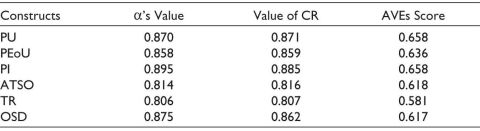
Note: PeoU: Perceived ease of use; PU: Perceived usefulness; ATSO: Attitude to shop online; PI: Personal innovativeness; TR: Trust; OSD: Online shopping decision.
The discriminant validity of the latent constructs was assessed by two major criteria, namely HTMT and the Fornell–Larcker criterion, to confirm the existence of significant differences among the proposed latent variables. Heterotrait–monotrait analysis (Henseler et al., 2016) recommends that the value of each construct should be <0.85. However, another study (Hair et al., 2017) proposed that 0.9 should be considered as the threshold value. Table 4 presents the HTMT ratio, and Table 5 shows the result of the Fornell–Larcker criterion.
Table 4. Results for Discriminant Validity (HTMT Ratio).

Note: PeoU: Perceived ease of use; PU: Perceived usefulness; ATSO: Attitude to shop online; PI: Personal innovativeness; TR: Trust; OSD: Online shopping decision.
Table 5. Result of Fornell–Larcker Criterion.

Structural Model Assessment
After confirming that the measurement model was satisfactory, the structural model was utilised to examine the relationships between the constructs using path analysis. The hypotheses were tested using 5,000 bootstrap resamples (Streukens & Leroi-Werelds, 2016).
For a comprehensive evaluation of the structural model, Henseler et al. (2016) recommend employing the standardised root mean square residual (SRMR) as a measure of model fit, with the criterion that it should be maintained at <0.10. The result of SRMR was 0.055. Furthermore, consistent with the approach outlined by Hair et al. (2017), the evaluation of the structural model’s explanatory capability involved the computation of R2 and Q2 values. The R2 values ranged between 0 and 1, with higher levels of R2 indicating higher values of explanatory power. In the context of consumer behaviour, the acceptable value of R2 is 0.2 or greater (Hair et al., 2016). The coefficient determination value (R2) for ATSO (0.787) and OSD (0.782) exceeded the recommended values. Furthermore, Stone–Geisser’s Q2 values above 0.50 depict the larger predictive relevance of the path model (Hair et al., 2017). The results indicated that OSD (Q2 = 0.778) and ATSO (Q2 = 0.756) had stronger predictive relevance as the values were greater than 0.50. The results are summarised in Table 6. Moreover, the magnitude and direction of the relationship among the variables were tested, and the results are presented in Table 7 and Figure 2.
Table 6. Results of Hypotheses’ Testing Corresponding to the TAM.

Table 7. Magnitude and Direction of the Relationship.
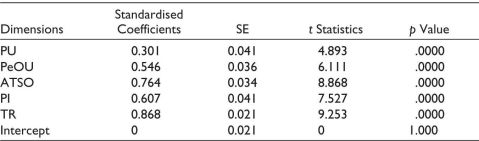
Figure 2. Results of the Path Model.

The path coefficient (0.570) and p value (.01) suggest a positive and significant relationship between PEoU and ATSO. The standardised coefficients (0.546, T value 6.111) of the variables are positive and significant at the 5% level of significance. This indicates that the easier an online platform is to use, the more favourable a buyer’s attitude towards online purchasing. The coefficient value (0.218) and p value (.01) demonstrate a significant impact of PU on ATSO. Similarly, the standardised coefficients (0.301, T value 4.893) of the variables are positive and significant at the 5% level of significance. This implies that if buyers perceive online shopping as beneficial, their attitude towards using it improves. The strongest direct effect was observed between PEoU and PU, indicating that the more user-friendly an online shopping platform is, the more useful consumers perceive it to be. Moreover, PI with a coefficient value (0.694) and p value (.01) as well as standardised coefficients (0.607, T value 7.527) also has a significant impact on ATSO as well as trust (coefficient value 0.452 and p value = .01). It implies that users’ knowledge and willingness to use technology reshape their attitude towards the technology and reduce the uncertainties of risk, thereby increasing trust. The result also reveals a strong positive effect between attitude towards shopping online (coefficient value 0.632, p value = .01, standardised coefficients 0.764, T value 8.868) and behavioural intention in the form of OSDs, confirming that a positive attitude significantly increases the likelihood of purchasing intention. Finally, results also reveal that trust (coefficient value 0.865, p value = .01, standardised coefficients 0.868, T value 9.253) plays a pivotal role in online shopping decisions. When the marketers ensure the risk-free as well as hassle-free use of technology, users paid highest attention to buy the products from digital platforms.
Thus, the study confirms that all hypothesised linkages in the model are statistically significant. PEoU significantly influences attitude towards online buying. Additionally, PU impacts attitude, which in turn affects behavioural intention.
Discussion
This study investigates the various antecedents that encourage the consumer to engage in online shopping to mitigate their need. The study proposes PI as the critical factor that has an immense impact on shaping the attitude of consumers towards online shopping. On the other hand, trust is considered an impactful antecedent influencing consumers’ decisions related to online shopping, and tests the impact of these concepts using the extended TAM model.
The findings indicate that consumers’ attitudes towards online shopping are shaped by how easy and useful they perceive the experience to be. Previous studies on online shopping behaviour (Elamin et al., 2025; Khatoon et al., 2024) reported comparable findings regarding consumers’ intentions to engage in online shopping in the post?COVID?19 period. In addition, the study of Soomro and Habeeb (2025), on impulsive purchases in the context of mobile commerce, found PU has a strong impact on attitude toward online shopping. The finding also portrays that PI plays a crucial role in shaping the attitude towards online shopping. A previous green product e-shopping study found a similar association (Chauhan et al., 2021). Thus, a positive attitude, which is an outcome of PEoU and PU, and consumer innovativeness leads to effective online shopping decisions.
Moreover, trust of the consumer towards online shopping is an important predictor that ultimately influence online shopping decisions, which confirms the finding of the previous study (Jalil et al., 2024; Rasty et al., 2021).
The study confirms the robustness of TAM, exploring the consumer behaviour towards acceptance of technology in online shopping. With the application of an extended TAM with two additional constructs (i.e., PI and trust), this study finds that attitude towards online shopping is influenced by PU, ease of use and PI. Similarly, a positive attitude towards online buying and trust leads to final buying decisions to buy the products from online platforms.
Conclusion
The findings of this study confirm that all hypothesised relationships in the model are statistically significant, highlighting key factors influencing consumers’ online shopping behaviour. The results indicate that PEoU significantly impacts consumers’ attitudes towards online purchasing. A user-friendly platform enhances both PU and attitude, ultimately shaping positive behavioural intentions.
Additionally, PU plays a crucial role in improving consumers’ attitudes, suggesting that when online shopping is perceived as beneficial, consumers are more likely to develop a favourable attitude towards it. PI and trust also emerge as significant determinants, reinforcing that consumers with higher technological adaptability and confidence in digital platforms are more inclined to engage in digital shopping.
Furthermore, the study reveals a strong link between attitude and behavioural intention, confirming that having a positive attitude greatly enhances the chances of making a purchase. Trust is identified as a pivotal factor in online shopping behaviour, with the highest coefficient value, underscoring the importance of ensuring risk-free and hassle-free experiences for consumers.
In conclusion, this study emphasises that user-friendly platforms, perceived benefits, trust and PI collectively shape online shopping behaviour. To enhance consumer engagement, online retailers should focus on improving platform usability, ensuring security and fostering consumer trust, ultimately driving higher purchase intentions and actual online shopping behaviour.
Implication of the Study
The factors influencing the online purchase decision have already been explored by previous research. However, most of the studies did not approach the object in an identical way or in the same way as the one we adopted. We considered all the important possible variables (variables of the TAM model and personal influencing factors like consumer innovativeness and trust) relating to online purchase decision into one single model. By considering a useful, holistic and comprehensive research framework, we suppose to make a significant contribution to the existing literature in consumer behaviour with special reference to the behaviour of digital natives.
The results of our study confirm those of previous studies that have used similar dimensions for empirical analysis; thus, the validity of the proposed hypotheses in our theoretical model has been well demonstrated regarding consumer preference towards online shopping. Therefore, given the advancement of technology and over changing nature of the digital buyers, the current study is a step towards offering insight into the use and acceptance of technology for online buying decisions.
By incorporating consumer innovativeness into this model, the study has given a new phenomenon that shapes attitude and OSD of individual consumers. Thus, the extended TAM model becomes comprehensive by acknowledging heterogeneity in the behaviour of consumers.
Moreover, the study adds trust as an important construct influencing online shopping decisions, reinforcing the idea that trust-related issues, like secure payment and user privacy, are essential preconditions for converting favourable perception about technology into actual buying behaviour.
Moreover, findings provide a crystal-clear roadmap for online retailers, particularly to increase their strategies for online business. Since PEoU positively impacted consumers’ shopping attitude, retailers should give emphasis on simplified navigation, user-centric interface, etc., to ensure user satisfaction and enhance users’ likelihood of making a buying decision. Similarly, the significant role of PU indicates that retailers should also focus on functional benefits of shopping online, including time saving, convenience and personalisation. Thus, retailers should emphasise the simple mechanism of online shopping that makes buying pleasant for consumers. Considering the consumer innovativeness which have an impact on shaping the attitude, retailers can target innovative customers as potential buyers and who spread positive word of mouth among conventional consumers. Finally, as trust emerged as a crucial determinant of online shopping behaviour, digital marketers should emphasise secure payment options, reliable information about products and effective customer support.
Future Avenues of the Study
Online platforms offer innumerable benefits to both sellers and buyers, and these advantages are also the reasons for the rising scope of online buying. This study examines the influence of six specific factors on online shopping behaviour. So, future studies can examine other factors like social influence, risk perception, digital shopping experience and others that have an impact on online shopping behaviour. Expanding this research to include other countries can provide deeper insights into people’s online shopping behaviours. We fail to consider the consumer culture to predict the behaviour of consumers towards online shopping decisions, thus future studies may consider cultural factors to provide more generalisable results towards the behaviour of online shoppers. Furthermore, researchers can focus on a daily diary study for investigating actual behaviour of online shoppers.
Declaration of Conflicting Interests
The authors declared no potential conflicts of interest with respect to the research, authorship and/or publication of this article.
Funding
The authors received no financial support for the research, authorship and/or publication of this article.
ORCID iD
Sudin Bag https://orcid.org/0000-0002-6289-245X
Ajzen, I., & Fishbein, M. (1980). Understanding attitudes and predicting social behaviour. Prentice-Hall.
Al-Nahdi, T. S., Habib, S. A., & Abbaas Albdour, A. (2015). Factors influencing the intention to purchase real estate in Saudi Arabia: Moderating effect of demographic citizenship. IJBM, 10(4), 35–48. http://dx.doi.org/10.5539/ijbm.v10n4p35
Bag, S., Ray, N., & Banerjee, B. (2021). Assessing the effects of experiential quality on behavioural intention of customers in banking services: The moderating role of experiential satisfaction. FIIB Business Review, 14(5), 23197145211052817.
Chauhan, H., Pandey, A., Mishra, S., & Rai, S. K. (2021). Modeling the predictors of consumers’ online purchase intention of green products: The role of personal innovativeness and environmental drive. Environment, Development and Sustainability, 23(11), 16769–16785.
Cohen, J. (1992). Quantitative methods in psychology: A power primer. Psychological Bulletin, 112(1), 155–159.
Cook, A. J., Kerr, G. N., & Moore, K. (2002). Attitudes and intentions towards purchasing GM food. Journal of Economic Psychology, 23(5), 557–572.
Daly, J., Gronow, S., Jenkins, D., & Plimmer, F. (2003). Consumer behaviour in the valuation of residential property: A comparative study in the UK, Ireland and Australia. Property Management, 21(5), 295–314.
Davis, F. D. (1989). Perceived usefulness, perceived ease of use, and user acceptance of information technology. MIS Quarterly, 13(3), 319–340. http://dx.doi.org/ 10.2307/249008
Elamin, A. M., Ali, L., Ahmed, A. Z. E., & Aldabbas, H. (2025). Factors affecting attitudes toward e-shopping in the United Arab Emirates. Cogent Business & Management, 12(1), 2442542.
Faul, F., Erdfelder, E., Buchner, A., & Lang, A.-G. (2009). Statistical power analyses using G*Power 3.1: Tests for correlation and regression analyses. Behavior Research Methods, 41(4), 1149–1160.
Fernandes, S., Venkatesh, V. G., Panda, R., & Shi, Y. (2021). Measurement of factors influencing online shopper buying decisions: A scale development and validation. Journal of Retailing and Consumer Services, 59, 102394.
Fornell, C., & Larcker, D. F. (1981). Evaluating structural equation models with unobservable variables and measurement error. Journal of Marketing Research, 18(1), 39–50.
Gefen, D., & Straub, D. W. (2000). The relative importance of perceived ease of use in IS adoption: A study of e-commerce adoption. Journal of the Association for Information Systems, 1(1), 8.
Gupta, A. S., & Mukherjee, J. (2022). Long-term changes in consumers’ shopping behavior post-pandemic: An exploratory study. International Journal of Retail & Distribution Management, 50(12), 1518–1534.
Hair, J., Hollingsworth, C. L., Randolph, A. B., & Chong, A. Y. L. (2017). An updated and expanded assessment of PLS-SEM in information systems research. Industrial Management & Data Systems, 117(3), 442–458.
Hair, J. F., Hult, G. T. M., Ringle, C. M., & Sarstedt, M. (2019). A primer on partial least squares structural equation modeling (PLS-SEM) (2nd ed.). Sage Publications.
Hair, Jr, J. F., Sarstedt, M., Matthews, L. M., & Ringle, C. M. (2016). Identifying and treating unobserved heterogeneity with FIMIX-PLS: Part I–method. European Business Review, 28(1), 63–76.
Hajli, N., Wang, Y., Tajvidi, M., & Hajli, M. S. (2017). People, technologies, and organizations interactions in a social commerce era. IEEE Transactions on Engineering Management, 64(4), 594–604.
Henseler, J., Ringle, C. M., & Sarstedt, M. (2016). Testing measurement invariance of composites using partial least squares. International Marketing Review, 33(3), 405–431.
Hsiu-Fen, L. (2007). Predicting consumer intentions to shop online: An empirical test of competing theories. Electronic Commerce Research and Applications, 6(2007), 433–442.
Hsu, C. L., Lin, J. C. C., & Chiang, H. S. (2013). The effects of blogger recommendations on customers’ online shopping intentions. Internet Research, 23(1), 69–88.
Hu, Z., Ding, S., Li, S., Chen, L., & Yang, S. (2019). Adoption intention of fintech services for bank users: An empirical examination with an extended technology acceptance model. Symmetry, 11, 340.
Huang, H. M., & Liaw, S. S. (2005). Exploring users’ attitudes and intentions toward the web as a survey tool. Computers in Human Behavior, 21(5), 729–743.
Huang, Z., & Benyoucef, M. (2013). From e-commerce to social commerce: A close look at design features. Electronic Commerce Research and Applications, 12(4), 246–259.
Indarsin, T., & Ali, H. (2017). Attitude toward using m-commerce: The analysis of perceived usefulness perceived ease of use, and perceived trust: Case study in Ikens wholesale trade, Jakarta–Indonesia. Saudi Journal of Business and Management Studies, 2(11), 995–1007.
Jalil, F., Yang, J., Al-Okaily, M., & Rehman, S. U. (2024). E-commerce for a sustainable future: Integrating trust, green supply chain management and online shopping satisfaction. Asia Pacific Journal of Marketing and Logistics, 36(10), 2354–2370.
Jayasubramanian, P., Sivasakthi, D., & Ananthi, P. K. (2015). A study on customer satisfaction towards online shopping. International Journal of Applied Research, 1(8), 489–495.
Khatoon, S., Anwar, I., Shamsi, M. A., & Chaudhary, A. (2024). Consumers’ behavioral intention toward online shopping in the post?COVID?19 period. International Journal of Consumer Studies, 48(1), e13001.
Kline, R. B. (2016). Principles and practice of structural equation modeling (4th ed.). The Guilford Press.
L?z?roiu, G., Neguri??, O., Grecu, I., Grecu, G., & Mitran, P. C. (2020). Consumers’ decision-making process on social commerce platforms: Online trust, perceived risk, and purchase intentions. Frontiers in Psychology, 11, 890.
Leckie, C., Nyadzayo, M. W., & Johnson, L. W. (2018). Promoting brand engagement behaviors and loyalty through perceived service value and innovativeness. Journal of Service Marketing, 32, 70–82.
Li, X., Chen, Z., & Sun, Y. (2022). A deep learning approach to predicting user behavior in web applications. Computers in Human Behavior, 105, 106–118.
Makmor, N., Aziz Abd, N., & Alam Shah, S. (2019). Social commerce an extended technology acceptance model: The mediating effect of perceived ease of use and perceived usefulness. Malaysian Journal of Consumer and Family Economics, 22, 119–136.
Numraktrakul, P., Ngarmyarn, A., & Panichpathom, S. (2012). Factors affecting green housing purchase. In the 17th International Business Research Conference.
O’Cass, A., & Carlson, J. (2012). An e-retailing assessment of perceived website-service innovativeness: Implications for website quality evaluations, trust, loyalty and word of mouth. Australasian Marketing Journal, 20, 28–36.
O’Dea, M. (2025). Are technology acceptance models still fit for purpose? Journal of University Teaching and Learning Practice, 21(8). https://doi.org/10.53761/1bdbms32
Or, C. (2024). Thirty-five years of the technology acceptance model: Insights from meta-analytic structural equation modelling. OTESSA Journal, 4(3), 1–26. https://doi.org/10.18357/otessaj.2024.4.3.66
Pavlou, P. A. (2003). Consumer acceptance of electronic commerce: Integrating trust and risk with the technology acceptance model. International Journal of Electronic Commerce, 7(3), 101–134.
Ramayah, T., Yusoff, Y. M., Jamaludin, N., & Ibrahim, A. (2009). Applying the theory of planned behavior (TPB) to predict internet tax filing intentions. International Journal of Management, 26(2), 272.
Rasty, F., Mirghafoori, S. H., Saeida Ardekani, S., & Ajdari, P. (2021). Trust barriers to online shopping: Investigating and prioritizing trust barriers in an intuitionistic fuzzy environment. International Journal of Consumer Studies, 45 1030–1046.
Rens, S. (2001). Supporting the online consumer decision process: Electronic commerce in a small Australian retailer. ACIS 2001 Proceedings, 75. https://aisel.aisnet.org/acis2001/75
Soomro, S. A., & Habeeb, Y. O. (2025). Impact of perceived ease of use on impulsive buying behaviour through mobile commerce with hedonic and utilitarian effects. Asia-Pacific Journal of Business Administration, 17(3), 796–813.
Streukens, S., & Leroi-Werelds, S. (2016). Bootstrapping and PLS-SEM: A step-by-step guide to get more out of your bootstrap results. European Management Journal, 34(6), 618–632.
Suleman, D., & Zuniarti, I. (2019). Consumer decisions toward fashion product shopping in Indonesia: The effects of attitude, perception of ease of use, usefulness, and trust. Management Dynamics in the Knowledge Economy, 7(2/24), 133–146.
Upadhyaya, N. (2024). Artificial intelligence in web development: Enhancing automation, personalization, and decision-making. Artificial Intelligence, 4(1), 12–28.
Venkatesh, V., & Davis, F. D. (2000). A theoretical extension of the technology acceptance model: Four longitudinal field studies. Management Science, 46(2), 186–204.
Vhatkar, M. S., Raut, R. D., Gokhale, R., Kumar, M., Akarte, M., & Ghoshal, S. (2024). Leveraging digital technology in retailing business: Unboxing synergy between omnichannel retail adoption and sustainable retail performance. Journal of Retailing and Consumer Services, 81, 104047.
Zhang, L., Chen, L., Wu, Z., Zhang, S., & Song, H. (2018). Investigating young consumers’ purchasing intention of green housing in China. Sustainability, 10, 1044.
