
Review of Professional Management

 Search
A. Maragathamuthu1 and P. Thillai Rajan2
1Department of Management Studies, Madurai Kamaraj University, Madurai, Tamil Nadu, India
2Department of Business Administration, Thiagarajar College, Madurai, Tamil Nadu, India

Creative Commons Non Commercial CC BY-NC: This article is distributed under the terms of the Creative Commons Attribution-NonCommercial 4.0 License (http://www.creativecommons.org/licenses/by-nc/4.0/) which permits non-Commercial use, reproduction and distribution of the work without further permission provided the original work is attributed.
This study investigates the ‘cultural-capability nexus’, examining how organisational readiness, defined through leadership commitment, employee empowerment and communicative transparency, acts as a primary driver for Lean Six Sigma (LSS) effectiveness and supply chain capacity optimisation. While traditional operations research focuses on technical throughput, this article conceptualises capacity as a strategic outcome of sociotechnical alignment. A quantitative cross-sectional survey was conducted among 378 supply chain professionals within the Indian manufacturing and logistics sectors. The sample featured a predominantly female (65.9%) and highly experienced workforce, with nearly 80% of respondents possessing over 5 years of industry tenure. Preliminary interviews were utilised to ensure content validity, followed by a structured questionnaire analysed via IBM SPSS (v28.0). Statistical analysis confirms that organisational barriers, specifically resistance to change (M = 4.16) and fragmented project communication (M = 4.25), significantly impede capacity gains. Conversely, the structural model validated six hypotheses, demonstrating that employee empowerment and involvement (EEI) and leadership support (LMS) are critical antecedents to a continuous improvement culture (CIC), with path coefficients exceeding 1.0. Measurement model results (CR > 0.97; AVE > 0.95) and the Fornell–Larcker criterion confirmed high internal consistency and discriminant validity. The findings provide a roadmap for managers to transition LSS from a perceived ‘unrecognised burden’ to a core operational competency. This research bridges the gap between organisational behaviour and operations management by empirically validating cultural readiness as the vital link in the capacity optimisation process.
Lean Six Sigma, organisational culture, capacity management, strategic preparedness, supply chain optimisation, operational excellence, change management
Introduction
In the contemporary industrial landscape, the ability to balance supply and demand amidst global disruptions is no longer merely an operational goal—it is a survival mandate. At the core of this balance lies capacity optimisation, which this study defines as the primary strategic outcome of integrated resource alignment and process efficiency. Despite its criticality, many firms suffer from ‘capacity-mismatch’, leading to either prohibitive overhead costs or lost revenue opportunities. While traditional operations literature focuses on the technical throughput of machinery and systems, this research argues that optimised capacity is fundamentally a sociotechnical achievement, rooted in the ‘Cultural-capability nexus’. The implementation of Lean Six Sigma (LSS) has long been a preferred methodology for reducing variability and enhancing output. However, the high failure rate of LSS initiatives suggests that technical preparedness alone is insufficient. As noted by Christopher (2000), the effectiveness of any operational strategy is contingent upon the organisation’s ability to respond to market signals with speed and precision— a trait often referred to as agility. In this context, agility serves as the vital link that enables a firm to transition from static resource management to dynamic capacity optimisation.
This study addresses a significant gap in the literature: the ‘black box’ of how internal organisational readiness, comprising leadership commitment, employee empowerment and communication, translates into measurable capacity sustainability. By moving beyond the ‘firm-as-actor’ perspective, we investigate how individual-level cultural readiness underpins macro-level capacity outcomes. Using a quantitative approach, this article seeks to theorise and validate a framework where cultural preparedness acts as the primary driver for LSS-enabled capacity excellence. Consequently, this research provides managers with a roadmap to treat capacity management not as a technical constraint, but as a dynamic result of sociotechnical alignment.
Research Questions and Objectives
Research Questions
RQ1: To what extent do specific dimensions of organisational culture, namely leadership advocacy, communicative transparency and employee empowerment, influence the efficacy of LSS initiatives in optimising supply chain capacity?
RQ2: Which cultural antecedents serve as critical success factors (CSFs), and conversely, which sociotechnical barriers act as primary inhibitors to sustainable capacity management?
Research Objectives
The primary aim of this study is to evaluate the ‘Cultural-Capability Nexus’ within the supply chain. Specifically, the research seeks:
Review of Literature
A robust body of literature explores the intersection of organisational culture and the success of quality and process improvement initiatives. This review is structured to first address the foundational interface between culture and LSS, followed by its specific application within the supply chain, and finally, its impact on capacity management. This synthesis provides a comprehensive overview of 40 influential articles and seminal texts examining the convergence of organisational culture, LSS and supply chain capacity optimisation. The sources are organised to highlight key theoretical developments and the evolution of research within this field.
Organisational Culture and LSS
Diverse studies identify senior management commitment as a CSF for LSS. Top-level administration must champion the movement, allocate necessary resources and communicate a coherent strategic vision. Without this visible support, practitioners may perceive LSS as a transient management fad. Another vital cultural dimension is employee empowerment and participation. When frontline agents are granted the autonomy and training to engage in improvement projects, they are more likely to internalise the change and contribute innovative solutions. Conversely, hierarchical or bureaucratic cultures that resist change and discourage bottom-up feedback often result in the stagnation of LSS initiatives (Breyfogle, 2003; Carnell, 2004).
Seminal research underscores the profound impact of organisational culture on the efficacy of LSS. Antony (2019) and Sroufe (2017) emphasise that a culture prioritising data-driven decision-making and continuous improvement is essential. Zu and Fredendall (2010) argue that supply chain integration is fundamental to LSS success, with internal cohesion and external responsiveness serving as vital cultural pillars. Furthermore, Liker (2004) posits that a culture centred on human capital and a persistent commitment to incremental improvement—termed Kaizen—underpins operational excellence. Carnell (2004) cautions that in the absence of a supportive culture, LSS devolves into a rigid framework executed by disengaged staff, highlighting the necessity of robust change management. Similarly, Achanga et al. (2006) observe that cultural transformation and employee commitment are central to sustainable Lean practices, while Srivastava (2007) asserts that successful strategic shifts within the supply chain depend upon a transparent and collaborative environment.
LSS in Supply Chain Management
The application of LSS within supply chains differs significantly from traditional manufacturing contexts; it necessitates cross-functional collaboration and a holistic view of the entire value stream, from raw material procurement to end-customer delivery. Research demonstrates that LSS can optimise order fulfilment, strengthen supplier relationships and reduce inventory levels (Zu & Fredendall, 2010). However, achieving these benefits is contingent upon a collaborative culture that dismantles functional silos between procurement, manufacturing and logistics. Without shared trust and a unified understanding, efforts to streamline the supply chain remain fragmented.
Recent scholarship reinforces the strong correlation between successful LSS deployment and a resilient hierarchical culture. Gomaa (2023, 2024) indicates that an integrated LSS framework, supported by a culture of continuous improvement, yields significant gains in efficiency and lead-time reduction. Roh et al. (2014) and Huo and Wang (2012) state that a collaborative and agile culture, rooted in trust and common objectives, is indispensable for effective supply chain integration. Ahlstrom (1998) characterises Lean implementation as a dynamic evolutionary process rather than an isolated event. Case studies by Lopes et al. (2015) and Lyons et al. (2011) emphasise the need for a culture of shared responsibility and collaborative problem-solving. Moreover, Vlachos (2015) provides empirical evidence demonstrating that culture acts as a mediator, directly influencing the extent to which lean strategies enhance supply chain performance (Cadden et al., 2013).
Critical Success Factors and Barriers
The implementation of LSS is frequently hindered by organisational culture, often leading to project failure. Gomaa (2022) identifies cultural friction as a primary deterrent to LSS initiatives in supply chains. Research by Losonci et al. (2017) and Breyfogle (2003) demonstrates that projects may fail—despite technical competence—if the social context is neglected. Scherrer et al. (2009) illustrate this through a case study where initial Lean adoption failed due to cultural unreadiness, succeeding only after social obstacles were addressed. Antony and Psomas (2018) identify employee reluctance and insufficient administrative support as significant barriers in the service sector. Furthermore, Shah and Ward (2003) found that a Lean strategy utilising a ‘practice bundle’ is more effective than isolated tools, provided the organisational culture supports comprehensive process changes across the entire firm.
Leadership and Employee Empowerment
Successful LSS implementation depends heavily on leadership commitment and employee engagement. Pande et al. (2000) emphasise the sustained dedication of senior leadership as a foundational factor. Antony and Banuelas (2002) and Ben Mabrouk and Jarraya (2020) further highlight the importance of active employee engagement. Henderson and Evans (2000) note that the success of organisations like General Electric underscores the need for a culture that integrates leadership and human resource operations with LSS. Kwak and Anbari (2006) and Jeyaraman and Teo (2010) argue that management participation, training and cultural shifts are essential components of effective LSS programmes. Finally, Patel and Dhillon (2021) assert that a positive culture enhances employee engagement, which subsequently acts as a mediator between LSS methodologies and organisational performance.
Emerging Research and Future Directions
Recent research substantiates the critical link between organisational culture and LSS achievement. Zaman and Ahsan (2014) propose that LSS efficacy should be evaluated using both quantitative indicators (e.g., lead time) and qualitative cultural factors. Wiengarten et al. (2015) confirm that culture functions as a mediator between Lean techniques and operational performance. For LSS initiatives to be truly effective, they must be embedded within the fundamental standards and traditions of an organisation (Linnenluecke & Griffiths, 2010). This cultural shift may not only precede LSS but also result from it; as Brodström (2019) suggests, the long-term use of LSS technologies can foster the evolution of a continuous improvement culture (CIC). Additionally, Soni and Jain (2020) argue that a culture of participation enhances supply chain resilience, while Gomaa (2024) underscore the significance of cultural readiness when synthesising LSS with broader transformation activities like business process re-engineering (BPR).
Research Methodology
Research Design
The research instrument consists of a structured survey developed from the conceptual themes identified in the literature review. This instrument was administered to a targeted sampling frame of supply chain professionals across the manufacturing sector. To ensure measurement validity, a five-point Likert scale was employed to operationalise dimensions of organisational culture, specifically leadership support (LMS), communicative transparency and employee empowerment, alongside perceived LSS performance metrics, such as lead-time reduction and inventory turnover. The hypothesised relationships between these cultural antecedents and LSS outcomes were empirically tested using multivariate statistical techniques, including correlation analysis and structural equation modelling (SEM), to determine path coefficients and model fit.
Sample and Data Collection
The research targeted supply chain and operations professionals within the Indian manufacturing and logistics sectors. A two-stage approach was employed: first, purposive sampling was used to conduct preliminary interviews with experts from organisations renowned for their LSS maturity. These interviews served exclusively to ensure content validity and refine the survey instrument. In the second stage, a quantitative cross-sectional survey was disseminated to 400 practitioners via professional networking platforms and industry associations. To ensure data quality, the inclusion criteria required participants to possess a minimum of 3 years of professional experience in LSS implementation. Of the distributed instruments, 378 valid responses were retrieved—representing a 94.5% response rate—which constitutes the final sample size ($N = 378$). This robust dataset was subsequently subjected to multivariate statistical analysis to evaluate the hypothesised relationships.
Data Analysis
Qualitative data obtained from the preliminary interviews were analysed using thematic analysis to refine the survey constructs and ensure content validity. The primary quantitative data were processed using IBM SPSS Statistics (Version 28.0) to test the research hypotheses. This sequential approach ensured that the survey instrument was grounded in practitioner reality, thereby enhancing the construct validity and reliability of the final results. Participants within the supply chain management sector were categorised by demographic variables, including age and professional experience, to allow for a nuanced analysis of the sample population.
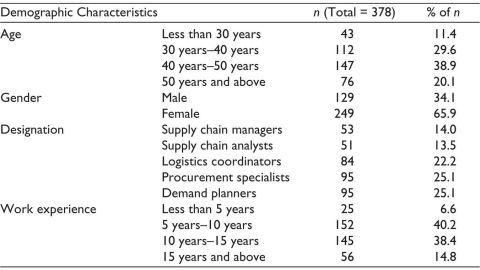
The demographic profile presented in Table 1 indicates that the largest age cohort among respondents is the 40–50 year range, accounting for 38.9% of the sample. Gender distribution is characterised by a female majority at 65.9%, compared to 34.1% male. Procurement professionals and demand planners represent a significant functional segment, comprising 25.1% of the total workforce. Regarding professional tenure, the data reflect a highly experienced personnel base: 40.2% of respondents possess 5–10 years of experience, while an additional 38.4% have 10–15 years, underscoring a high level of domain expertise within the surveyed population.
Table 1. Demographic Background of Employees in Supply Chain Management.
Source: Primary data.
Note: n = number of respondents.
As illustrated in Table 2, the primary deterrents to LSS implementation are identified as resistance to change, inadequate incentives for supplementary labour and ambiguous communication. All three constructs yielded high mean values, reflecting a strong consensus among the 378 respondents. Specifically, a mean score of 4.16 highlights significant employee resistance to LSS-driven process enhancements. Furthermore, the perception of LSS initiatives as uncompensated or unrecognised additional work was equally prominent, also returning a mean of 4.16. The most critical challenge identified was the lack of clarity regarding project objectives and communication, which attained the highest mean score of 4.25.
Table 2. Mean Score Analysis on Barriers in Capacity Management.
.jpg/10_1177_09728686261445287-table2(1)__480x132.jpg)
Source: Statistically calculated data.
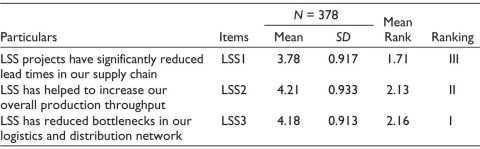
The empirical results presented in Table 3 indicate that LSS significantly optimises supply chain capacity by mitigating bottlenecks, enhancing production throughput and reducing lead times. Specifically, LSS was found to most effectively alleviate constraints within logistics and delivery systems, as evidenced by the highest mean rank of 2.16. The second most significant benefit identified was the improvement of production throughput, which achieved a mean rank of 2.13. Furthermore, the reduction of supply chain lead times was ranked third, with a mean rank of 1.71. The high mean scores across all categories (4.18, 4.21 and 3.78, respectively) confirm a strong consensus among the 378 respondents that LSS initiatives are instrumental in driving capacity optimisation.
Table 3. Mean Score Analysis on Lean Six Sigma in a Supply Chain Capacity Management.
Source: Statistically analysed data.
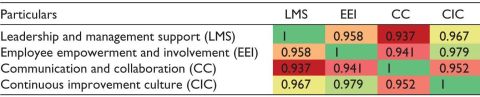
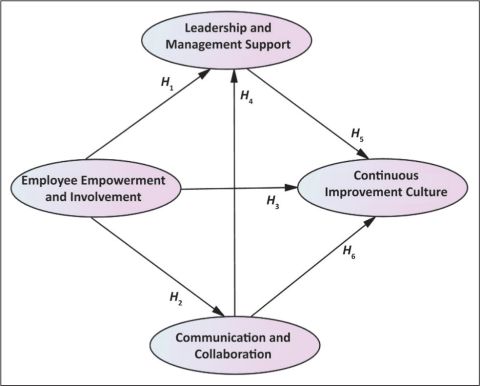
The Pearson correlation matrix presented in the heat-map (Table 4) reveals strong positive associations across all four dimensions of LSS organisational culture. Correlation coefficients exceeding 0.92 indicate a high degree of interdependence among these constructs. The most significant relationship (r = 0.979) was observed between employee empowerment and involvement (EEI) and a CIC, suggesting that an engaged workforce is a primary catalyst for sustained operational refinement. Additionally, leadership and management support (LMS) demonstrate a robust correlation (r = 0.967) with CIC, reinforcing the premise that strategic leadership is essential for institutionalising improvement mindsets. Other notable associations, such as LMS with EEI (0.958) and collaborative communication (CC) with CIC (0.952), further underscore a high level of thematic convergence within the organisational culture framework. This conceptual framework (as shown in Figure 1) illustrates the interconnected relationships between four key organizational pillars—leadership, employee empowerment, communication, and culture—mapped through six distinct hypotheses (H_1 to H_6).
Table 4. Heat-map Correlation for Key Dimensions of Organisational Culture in Lean Six Sigma.
Source: Statistically analysed data.
Figure 1. Result of Hypotheses Testing for Key Dimensions of Organisational Culture in Lean Six Sigma.
Source: Statistically Analysed Data.
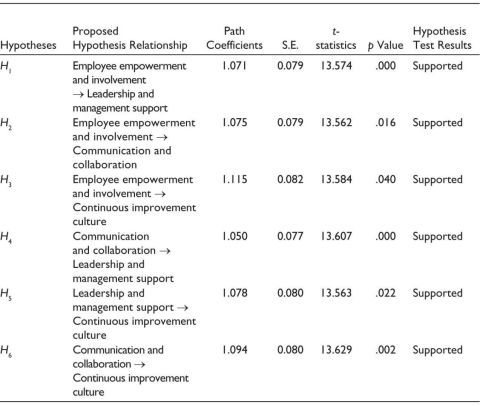
The structural model results presented in Table 5 provide empirical support for all six hypothesised relationships concerning the cultural dimensions of LSS. The analysis confirms that EEI serve as a primary antecedent, exerting a significant positive influence on LMS (beta = 1.071), communication and collaboration (CC) (beta = 1.075), and a CIC (beta = 1.115). Furthermore, CC was found to significantly impact both LMS (beta = 1.050) and CIC (beta = 1.094). Finally, the path from LMS to CIC demonstrated a strong positive effect (Path Coefficient: 1.078). All hypothesised paths reached statistical significance with p values consistently below the .05 threshold, validating the integrated nature of the proposed sociotechnical framework.
Table 5. Result of Hypotheses Testing for Key Dimensions of Organisational Culture in Lean Six Sigma.
Source: Statistically analysed data.
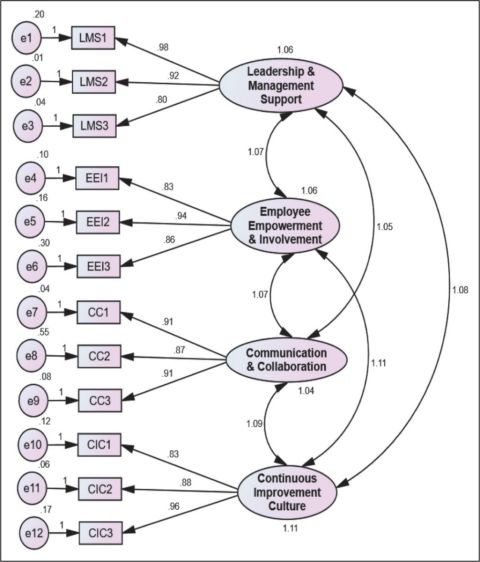
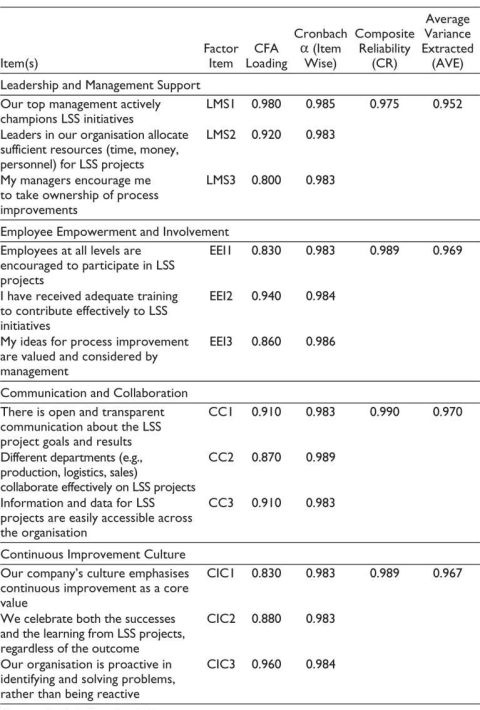
This measurement model (as shown in Figure 2) illustrates the multidimensional structure of organizational culture in a Lean Six Sigma context, specifically validating the causal links between leadership, empowerment, and communication. The results of the measurement model presented in Table 6 demonstrate high internal consistency and strong convergent validity across the four dimensions of LSS organisational culture: LMS, EEI, CC and CIC. Cronbach’s alpha coefficients for the constructs range from 0.983 to 0.989, indicating robust scale reliability. These findings are further corroborated by composite reliability (CR) values ranging from 0.975 to 0.990, well above the recommended threshold. Additionally, the average variance extracted (AVE) values range from 0.952 to 0.970; as these significantly exceed the 0.50 benchmark, it is confirmed that each construct accounts for a substantial proportion of item variance. Finally, confirmatory factor analysis (CFA) loadings range from 0.800 to 0.980, validating that the indicators effectively represent their respective latent constructs and affirming the overall reliability of the measurement instrument.
Figure 2. Measurement Model of Key Dimensions of Organisational Culture in Lean Six Sigma.
Source: Model framed during research study.
Table 6. Measurement Model of Key Dimensions of Organisational Culture in Lean Six Sigma.
Source: Statistically analysed data.
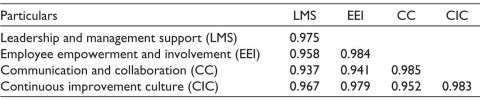
Table 7 presents the results of the Fornell–Larcker criterion analysis, which confirms the discriminant validity of the four core dimensions: LMS, EEI, CC and CIC. To satisfy this criterion, the square root of the AVE represented by the bolded diagonal values must exceed the inter-construct correlation coefficients within its respective row and column. As illustrated, the square root of the AVE for each construct consistently surpasses its correlation with all other latent variables. For instance, the square root of the AVE for LMS (0.975) is higher than its correlations with EEI (0.958), CC (0.937) and CIC (0.967). This pattern is maintained across all four dimensions, empirically validating that each construct represents a distinct and unique theoretical concept within the framework.
Table 7. Discriminant Validity: Fornell–Larcker Criterion for Key Dimensions of Organisational Culture in Lean Six Sigma.
Source: Statistically analysed data.
Findings
The demographic analysis reveals that the supply chain management workforce is predominantly female, featuring a significant concentration of procurement specialists and demand planners with substantial industry expertise. Despite the demonstrated efficacy of LSS in mitigating operational challenges and enhancing production throughput, internal organisational barriers frequently impede the realisation of its full potential. Specifically, the perception of LSS as uncompensated supplementary labour, employee resistance to change and fragmented communication regarding project objectives emerged as primary obstacles. Furthermore, the research identifies a strong correlation between successful LSS implementation and several critical cultural dimensions. A culture oriented towards continuous improvement is significantly bolstered by robust leadership advocacy, employee empowerment and cross-functional cooperation. Ultimately, the validated hypotheses and structural model results demonstrate that a supportive organisational culture is an indispensable prerequisite for the success of LSS initiatives.
Discussions and Suggestions
The findings indicate that while LSS initiatives enhance supply chain capacity by mitigating operational bottlenecks and increasing throughput, organisational constraints continue to impede their overall efficacy. Significant barriers include employee resistance to change, the perception of LSS as an ancillary or uncompensated burden, and fragmented communication channels. This study demonstrates that a culture of continuous improvement premised on leadership advocacy, employee empowerment and cross-functional collaboration is a prerequisite for strategic success. To institutionalise these gains, organisations must refine project-level communication, establish tangible incentives for engagement and ensure adequate resource allocation. By integrating staff into decision-making frameworks and providing comprehensive training, firms can redefine LSS as an indispensable operational competency rather than a discretionary responsibility.
To align with the standards of high-impact journals, this section acknowledges the study’s boundaries with academic humility while providing a strategic roadmap for future researchers.
Limitations and Future Scope
Limitations of the Study
Despite the significant empirical findings, this research acknowledges several limitations that should be considered when interpreting the results. First, the study utilised a cross-sectional design, capturing organisational readiness and capacity outcomes at a single point in time. This prevents the establishment of long-term causal relationships, as cultural transformation is a longitudinal process.
Second, the geographic focus was restricted to the Indian manufacturing and logistics sectors. While this provides valuable insights into an emerging economy, the findings may not be fully generalisable to different cultural or institutional contexts, such as Western or East Asian supply chains, where organisational hierarchies and communication norms may vary.
Third, the study relied on self-reported, perceptual data from supply chain professionals. While this is appropriate for assessing organisational culture, it may introduce common method bias. Finally, the high correlation coefficients observed between cultural constructs suggest a high degree of multicollinearity, indicating that these variables are deeply intertwined and difficult to isolate in a practical setting.
Future Research Directions
Building upon the ‘Cultural-Capability Nexus’ framework, future research should consider several avenues:
Boundary Conditions: Organisational Scale and Complexity
While the proposed ‘Cultural-capability nexus’ provides a robust framework for capacity optimisation, its application is subject to specific boundary conditions, particularly regarding organisational size and resource configuration.
Large corporations versus SMEs: In large corporations, the primary challenge to the nexus is often structural inertia and the presence of functional silos. In these environments, while ‘LMS’ may be formalised, the ‘CC’ dimension frequently suffers due to complex hierarchical layers. Consequently, LSS initiatives in large firms may be technically sound but culturally fragmented, requiring more aggressive ‘Employee empowerment’ to bridge the gap between executive vision and frontline execution.
Conversely, in small-to-medium enterprises (SMEs), the nexus operates under a different set of constraints. SMEs typically possess a more fluid and organic culture, which can accelerate ‘CIC’ due to shorter communication loops. However, they often lack the resource slack—both financial and human—to support the ‘unrecognised supplementary work’ of LSS. In this context, the boundary condition for success shifts from cultural alignment to resource availability. Without the ‘Asset Assignment’ mentioned in this study, even a highly motivated SME culture will struggle to translate readiness into measurable capacity optimisation.
Conclusion
Empirical evidence suggests that while LSS initiatives significantly optimise supply chain capacity by mitigating operational bottlenecks and enhancing throughput, their long-term sustainability is often compromised by sociocultural barriers. Critical impediments include employee resistance to organisational change, the perception of LSS as an ancillary or uncompensated burden and systemic communication failures. This study demonstrates that a culture of continuous improvement premised on robust leadership commitment, employee empowerment and cross-functional collaboration is a prerequisite for success. To institutionalise LSS, organisations must enhance project-level communication, establish clear incentives for engagement and ensure adequate resource allocation. By integrating staff into decision-making processes and providing comprehensive training, firms can transition LSS from a perceived discretionary task to an indispensable core operational competency.
Declaration of Conflicting Interests
The authors declared no potential conflicts of interest with respect to the research, authorship and/or publication of this article.
Funding
The authors received no financial support for the research, authorship and/or publication of this article.
ORCID iD
A. Maragathamuthu https://orcid.org/0000-0003-1159-074X
Achanga, P., Shehab, E., Roy, R., & Nelder, G. (2006). Critical success factors for lean implementation within SMEs. Journal of Manufacturing Technology Management, 17(4), 460–474.
Ahlstrom, P. (1998). Sequences in the implementation of lean production. European Journal of Innovation Management, 1(2), 89–106.
Antony, J. (2019). Six sigma and organizational culture: An empirical study. International Journal of Quality & Reliability Management, 36(2), 273–289.
Antony, J., & Banuelas, R. (2002). Key ingredients for the effective implementation of a six sigma programme. Journal of Manufacturing Technology Management, 13(7), 478–483.
Antony, J., & Psomas, E. (2018). Critical success factors of lean six sigma in service organizations. The TQM Journal, 30(5), 577–593.
Ben Mabrouk, N., & Jarraya, B. (2020). Factors influencing the performance of supply chain management in Saudi SMEs. Journal of Financial and Management Sciences, 3(1), 1–15.
Breyfogle, F. B. (2003). Implementing six sigma: Smarter solutions using statistical methods. Wiley.
Brodström, F. (2019). The role of lean tools in developing a culture of continuous improvement. Total Quality Management & Business Excellence, 30(9–10), 1018–1033.
Cadden, T., O’Malley, S., & Prizeman, G. (2013). Organizational culture and the adoption of green supply chain management. Management Research Review, 36(6), 576–593.
Carnell, B. (2004). Managing change in organizations. Pearson Education.
Gomaa, A. H. (2022). Lean six sigma for improving supply chain management: A literature review. Operations and Supply Chain Management: An International Journal, 15(4), 415–427.
Gomaa, A. H. (2023). Improving supply chain management using lean six sigma: A case study. Journal of Operations and Supply Chain Management, 16(3), 11–25.
Gomaa, A. H. (2024). Boosting supply chain effectiveness with lean six sigma. Journal of Management and Business Review, 7(1), 45–60.
Henderson, K. M., & Evans, J. R. (2000). Successful implementation of six sigma: Benchmarking general electric company. Benchmarking: An International Journal, 7(4), 260–282.
Huo, B., & Wang, Z. (2012). The impact of supply chain integration on firm performance. Service Systems and Service Management (ICSSSM), 2012 9th International Conference on, IEEE, 584–589.
Jeyaraman, K., & Teo, L. K. (2010). A conceptual framework for critical success factors of lean six sigma. International Journal of Lean Six Sigma, 1(4), 282–297.
Kwaki, E., & Anbari, A. (2006). A framework for success: Critical success factors for six sigma implementation. International Journal of Quality & Reliability Management, 23(1), 12–25.
Liker, J. K. (2004). The Toyota way: 14 management principles from the world’s greatest manufacturer. McGraw-Hill.
Linnenluecke, M. K., & Griffiths, A. (2010). Corporate strategy, organizational culture and sustainability. Journal of Corporate Citizenship, 40, 47–64.
Lopes, G. F., Mello, C. H. P., & Pires, S. R. I. (2015). The role of organizational culture in lean implementation: A case study in a manufacturing company. Journal of Operations and Supply Chain Management, 8(2), 162–178.
Losonci, D., Demeter, K., & Szász, L. (2017). Factors influencing the success of lean implementation: Operationalizing the ‘soft’ side. International Journal of Production Economics, 185, 162–174.
Lyons, A. C., Vidamour, K., Jain, R., & Sutherland, M. (2011). Developing an understanding of lean thinking in process industries. Business Process Management Journal, 17(3), 475–493.
Pande, P. S., Neuman, R. P., & Cavanagh, R. R. (2000). The Six Sigma Way: How GE, Motorola, and Other Top Companies are Honing Their Performance. McGraw-Hill.
Patel, G. A., & Dhillon, S. (2021). Identification and analysis of barriers to lean manufacturing implementation in SMEs. Materials Today: Proceedings, 47, 3215–3221.
Roh, J., Hong, P., & Min, H. (2014). Implementation of a responsive supply chain strategy in global complexity: The case of manufacturing firms. International Journal of Production Economics, 147, 198–210. (Note: Often cited as 2013 in early-access/online versions).
Scherrer-Rathje, M., Arnoscht, J., & Friese, M. (2009). Schneider’s journey to lean: A case study. International Journal of Production Economics, 122(2), 541–554.
Shah, R., & Ward, P. T. (2003). Lean manufacturing: Context, practice bundles, and performance. Journal of Operations Management, 21(2), 129–149.
Soni, G., & Jain, V. (2020). Analysis of lean manufacturing implementation barriers in Indian SMEs. International Journal of Productivity and Performance Management, 69(1), 1–22.
Srivastava, S. K. (2007). Green supply-chain management: A state-of-the-art literature review. International Journal of Management Reviews, 9(1), 53–80.
Sroufe, R. (2017). Integration and organizational change towards sustainability. Journal of Cleaner Production, 162, 1634–1651.
Vlachos, I. (2015). The mediating role of organizational culture in the relationship between lean management and supply chain performance. International Journal of Operations & Production Management, 35(1), 122–140.
Wiengarten, F., Pagell, M., & Fynes, B. (2015). The role of organizational culture in the relationship between lean management and operational performance. Journal of Operations Management, 34–35, 1–13.
Zaman, K. A., & Ahsan, A. M. M. N. (2014). Lean supply chain performance measurement. International Journal of Business and Social Science, 5(2), 24–35.
Zu, X., & Fredendall, L. D. (2010). The impact of organizational culture on supply chain integration: A contingency and configuration approach. Supply Chain Management: An International Journal, 15(1), 24–41
