Review of Professional Management

Pooja Singh Negi1  and Mansi Sharma1
1Department of Management Studies, Management Education and Research Institute, New Delhi, Delhi, India

Creative Commons Non Commercial CC BY-NC: This article is distributed under the terms of the Creative Commons Attribution-NonCommercial 4.0 License (http://www.creativecommons.org/licenses/by-nc/4.0/) which permits non-Commercial use, reproduction and distribution of the work without further permission provided the original work is attributed.
Financial institutions play a pivotal role in India’s economic development by offering loans, advances and asset management services. This study conducts a comprehensive comparative analysis of the financial performance of the Delhi Financial Corporation (DFC) and the Kerala Financial Corporation (KFC) over a five-year period, emphasising liquidity, profitability, solvency and asset utilisation. Using secondary data extracted from annual reports and official financial disclosures, the study employs a series of financial ratios—including current ratio, quick ratio, return on assets, return on equity, debt-to-equity and asset turnover—to evaluate the fiscal health of both institutions. The findings reveal a stark divergence in financial trajectories: DFC exhibits declining liquidity, substantial accumulated losses, high leverage and inefficient asset utilisation, signalling financial distress and long-term sustainability risks. In contrast, KFC demonstrates consistent profitability, stronger liquidity management, healthier solvency ratios and superior operational efficiency, indicating financial resilience. The comparative insights underscore the need for strategic restructuring, improved credit risk management and operational optimisation in DFC, while positioning KFC as a benchmark for stability among state-level financial corporations. This study contributes to institutional financial analysis literature by highlighting how structural, policy and operational differences shape financial outcomes across public-sector financial institutions in India.
Financial performance (inter-firm) comparison, solvency, efficiency, liquidity and profitability
Bhoi, B., & Sahoo, S. (2020). Development finance institutions and regional industrial growth in India. Journal of Economic Development Studies, 12(3), 45–57.
Chattopadhyay, T. (2020). Non-performing assets and financial health of state finance corporations in India. Indian Journal of Finance and Banking, 9(2), 33–48.
Delhi Financial Corporation. (Various years). Annual reports for the years 2019, 2020, 2021, 2022 and 2023 manually collected from the office. https://www.google.com/delhi+financial+corporation;??https://www.google.com/search?q=financialanalysis&oq=financial+analysis; https://www.google.com/search?q=ratio+analysis
Few, S. (2012). Show me the numbers: Designing tables and graphs to enlighten (2nd ed.). Analytics Press.
Gopakumar, K. (2005). Financial performance assessment of public sector financial institutions in India. Journal of Financial Management and Analysis, 18(2), 45–58.
Gitman, L. J., & Zutter, C. J. (2018). Principles of managerial finance (15th ed.). Pearson.
Johnston, M. P. (2017). Secondary data analysis: A method of which the time has come. Qualitative and Quantitative Methods in Libraries, 3(3), 619–626.
Kothari, C. R. (2004). Research methodology: Methods and techniques (2nd ed.). New Age International.
Kumar, R., & Joseph, A. (2021). Financial sustainability of state industrial development corporations in India: A comparative analysis. South Asian Journal of Business and Management, 8(1), 72–89.
Mishra, P., & Singh, S. (2020). Inter-firm financial performance analysis: A study of Indian public sector enterprises. Management Review Quarterly, 70(4), 501–518.
Mohan, R. (2021). Evolution and relevance of development finance institutions in India. Economic & Political Weekly, 56(4), 40–48.
Narasimham, S. (2021). Reforming development finance institutions: Issues and policy options. Journal of Public Financial Management, 14(2), 19–34.
Pandey, I. M. (2019). Evaluating financial performance of public financial institutions: A ratio-based perspective. Finance India, 33(1), 101–120.
Rao, K., & Anwar, S. (2020). Financial distress and recovery patterns in state-level financial institutions. Indian Journal of Economics and Development, 16(2), 115–126.
Rawat, D. S. (2017). Accounting ratios and corporate performance: An empirical study of Indian finance corporations. Indian Journal of Accounting, 49(1), 72–84.
Sharma, V., & Bansal, N. (2022). A five-year financial performance assessment of selected Indian financial institutions. International Journal of Accounting Research, 10(1), 84–96.
White, G. I., Sondhi, A. C., & Fried, D. (2003). The analysis and use of financial statements (3rd ed.). Wiley.
Appendix
Table A1. Computation of Financial Ratios of Delhi Financial Corporation and Kerala Financial Corporation for the Last Three Years.
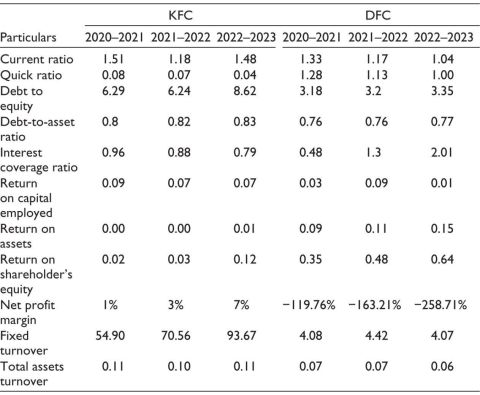
Source: Compiled from DFC Annual Reports (2019–2023) and KFC Official Website Data (2019–2023).
Figure A1. Current Ratio of KFC and DFC.
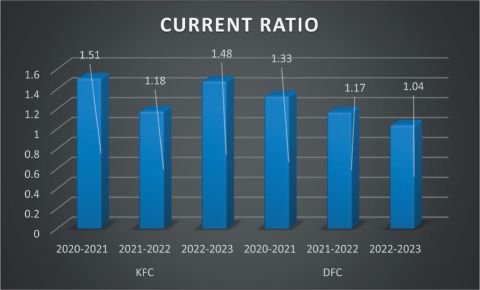
Source: Delhi Financial Corporation Annual Report (2023).
Figure A2. Quick Ratio of KFC and DFC.
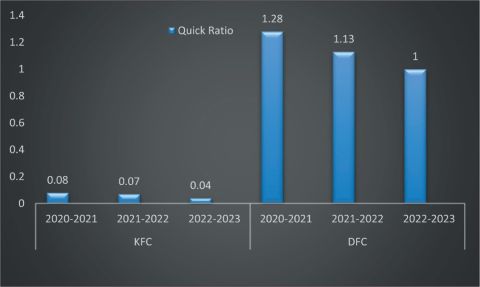
Figure A3. Debt-to-equity Ratio of KFC and DFC.
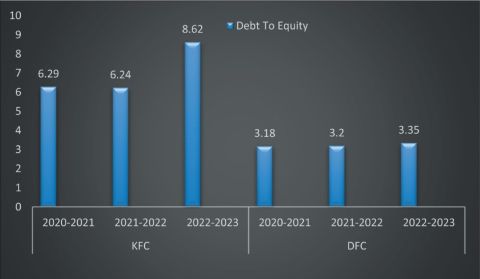
Figure A4. Debt-to-asset Ratio of KFC and DFC.
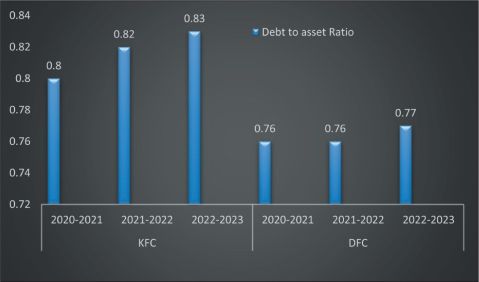
Source: Author’s analysis based on secondary data from DFC and KFC annual reports.
Figure A5. Interest Coverage Ratio of KFC and DFC.
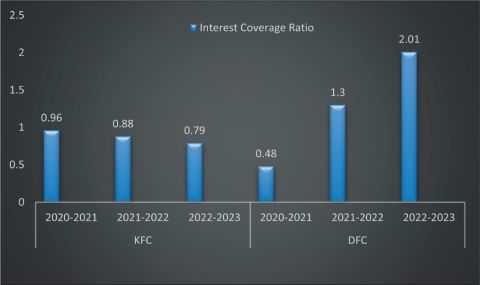
Figure A6. ROCE Ratio of KFC and DFC.
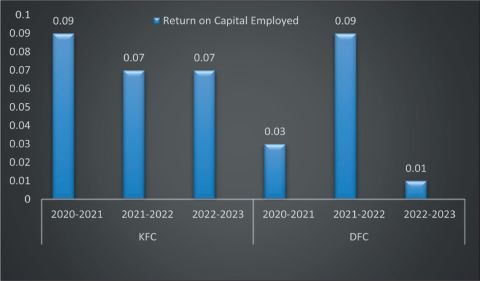
Figure A7. ROCE Ratio of KFC and DFC.
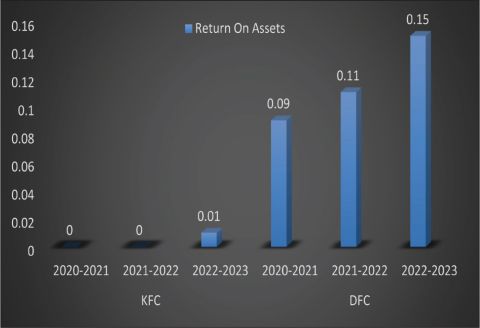
Figure A8. Return on Shareholders’ Equity of KFC and DFC.
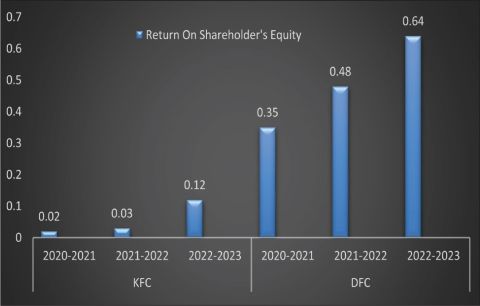
Figure A9. Net Profit of KFC and DFC.
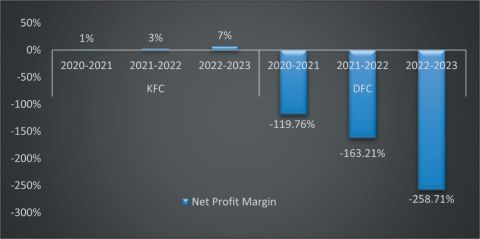
Figure A10. Fixed Assets Turnover of KFC and DFC.
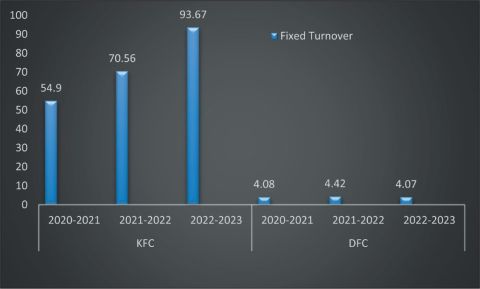
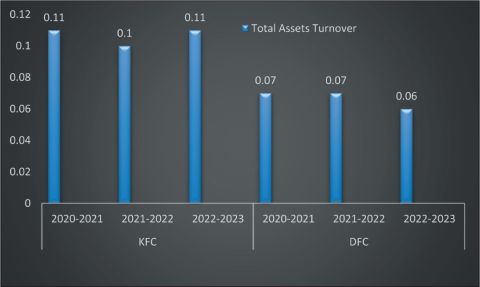
Figure A11. Total Asset Turnover of KFC and DFC.